The screening of Human Immunodeficiency Virus (HIV) is a critical component of public health efforts to combat the spread of HIV and improve health outcomes for those living with the virus.1,2 In Mississippi, a state with unique socio-economic and healthcare challenges, understanding the factors associated with HIV testing among adults is essential for designing effective interventions and policies. Particularly, Mississippi of all the states in the United States, faces unique challenges related to HIV screening due to its demographic, socio-economic, and healthcare landscape.3
Mississippi is characterized by a population of low socioeconomic status and educational attainment, evidenced by high rates of poverty, illiteracy, unemployment, and uninsured individuals.4,18 In addition, there exist significant disparities in health, income, education, and access to healthcare in the state,16,18 and thereby impacting HIV-care services utilization.17 Furthermore, the predominantly rural population in Mississippi poses additional challenges, including limited access to healthcare services,18 further complicating HIV testing efforts.5,17 Individuals in rural Mississippi have additional barrier to access HIV care due to an inadequate public transportation system4,17 besides the shortage in the health workforce in the rural areas.18 Nonetheless, there have been notable efforts to increase HIV testing rates in the state. Public health campaigns, community outreach programs, and policy initiatives have been implemented to encourage testing and reduce the stigma associated with HIV.4 These efforts are critical in Mississippi where HIV prevalence and incidence rates, HIV-related morbidity, and mortality are relatively high, particularly among certain demographic groups such as African Americans and men who have sex with men (MSM).5
Several factors are believed to be associated with HIV testing among Mississippi adults. Among others are demographic variables such as age, gender, race, locality, education, and socio-economic status, as well as access to healthcare services and awareness of HIV-related information.5,6 These factors play crucial roles in shaping individuals’ likelihood to seek HIV testing. For instance, it is believed that young age, higher levels of education, and better access to healthcare are generally more likely to be associated with HIV testing.7 Conversely, stigma, lack of awareness, and limited healthcare access can significantly impede testing efforts.8
Further, policy interventions and community-based programs play a crucial role in molding HIV testing behaviors. The implementation of the Affordable Care Act, improved funding for HIV prevention and care services, and targeted outreach efforts by the Mississippi State Department of Health (MSDH), Center for Disease Control and Prevention (CDC), non-profit organizations, and other partners are capable of influencing HIV testing rates by providing free or subsidized testing services and conducting educational outreach to raise awareness on the importance of early HIV detection.5
The impacts of socio-demographic characteristics on HIV screening have been well documented in many parts of the United States, however, such contextual evidence is scarce for Mississippi. Therefore, this study will focus on examining the relationships between socio-demographic factors and HIV screening to provide valuable insights into the strategic changes needed to more effectively combat the HIV epidemic in Mississippi. We will utilize the most recent BRFSS data to identify the key socio-demographic drivers of HIV testing behaviors among the adult population and highlight areas for improvement. Our goal is to contribute to the ongoing public health efforts to enhance HIV testing rates, reduce new HIV infections, and improve the overall health outcomes for people living with HIV in Mississippi.
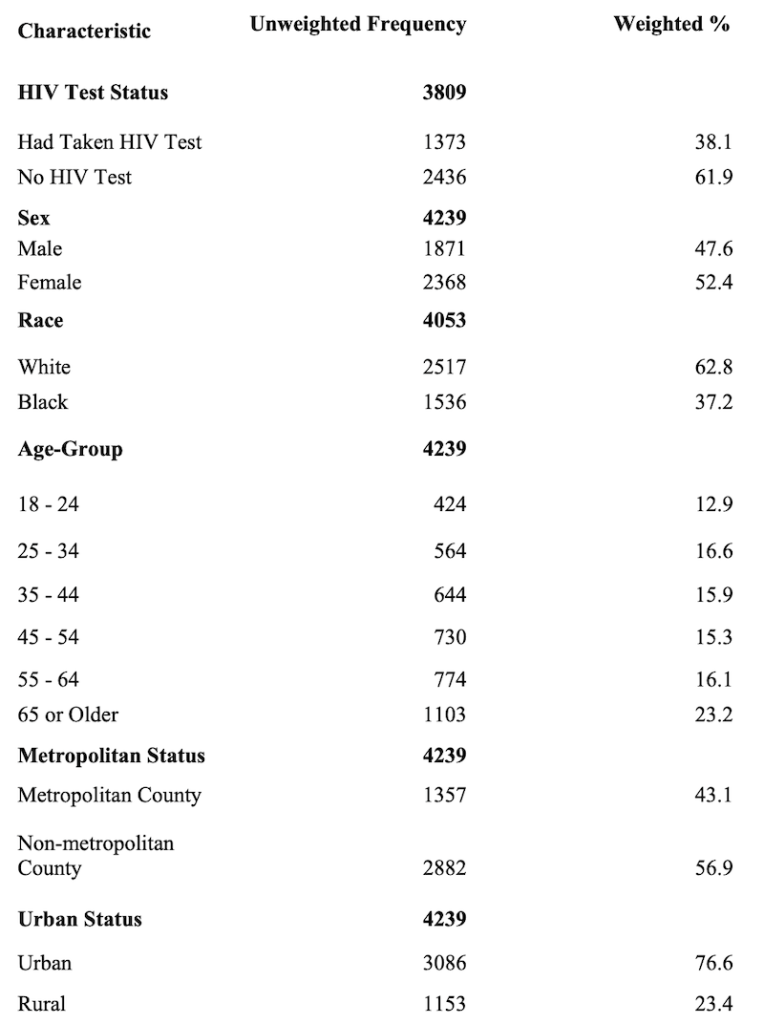
The 2022 Behavioral Risk Factor Surveillance System (BRFSS) dataset for Mississippi was used for this study. We obtained data for 4239 adults. BRFSS is a state-level, random telephone survey that targets the noninstitutionalized civilian adult population (18 years old and above) in all fifty states of the United States, the District of Columbia, and some U.S. territories. BRFSS data is collected through landline and cellular telephone interviews. Complex sampling design and weighting procedures are utilized to improve the population representativeness of BRFSS data.9
The responses to the variable “ever tested for HIV” in the 2022 BRFSS dataset were dichotomized to facilitate logistic regression modeling. Specifically, participants were asked the question: “Including fluid testing from your mouth, but not including tests you may have had for blood donation, have you ever been tested for HIV?” This study delimited its scope to observations with affirmative (“yes”) or negative (“no”) responses to the aforementioned “ever tested for HIV” variable in the 2022 BRFSS dataset. We excluded observations deemed invalid or inappropriate based on responses or due to missing values for the dependent variable. Furthermore, participants with missing data at the covariate level analysis were excluded as well. The threshold for statistical significance was set at alpha being 0.05.
The dependent variable, “ever tested for HIV,” was encoded as (0) for respondents who had never undergone HIV testing and as (1) for those who had been tested for HIV at any point. The sample size for analysis was 4239, reflective of exclusions dictated by study criteria. Covariates considered in both bivariate and multivariate analyses encompassed age categories, sex, income level, educational attainment, race, marital status, health insurance coverage, metropolitan residence status, and urban domicile status. Metropolitan status denotes whether respondents reside within a county within metropolitan areas. Marital status, income level, and health insurance status were re-categorized and suitably encoded for analysis in this study. Recategorization was accomplished by consolidating small and single response groups into larger categories. For instance, health insurance status was originally classified by specific types of insurance. In our study, these responses were re-categorized into two groups: insured and uninsured. It was essential to recategorize responses to enhance statistical power for subgroup analyses, thereby augmenting the overall robustness of the analysis and the interpretability of the results
We conducted data analysis using version 29.0.1.0 (171) of the Statistical Package for the Social Sciences (SPSS). All estimations were executed within the Complex Samples module of the statistical software to address the complex sampling design inherent in BRFSS data, ensuring appropriate estimation of variance. Descriptive statistics were employed to characterize the study variables, while the association between HIV testing and predictor variables was examined via bivariate and multivariate logistic regression models. Covariates exhibiting significance at p < 0.2 in the bivariate analysis were incorporated into the multivariate logistic regression model to account for possible interactions between variables. The association outcomes are present as Odds Ratios; specifically, Crude Odds Ratios (COR) for the bivariate analysis and Adjusted Odds Ratios (AOR) for the multivariate analysis. Additionally, secondary analyses were performed to assess the presence of multicollinearity.
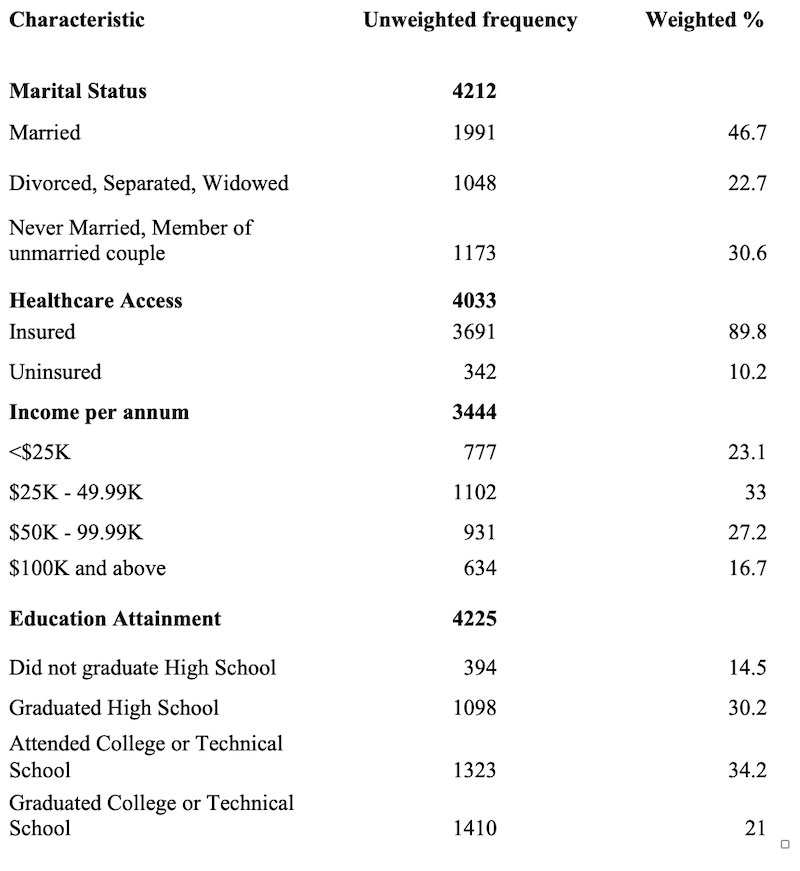
38.1% of Mississippi adults 18 years and older had tested for HIV in 2022, with 52.4% female, 62.8% White, and 89.8% having health insurance coverage. Details of the sample characteristics are shown in Tables 1 and 2 below in the tables section.
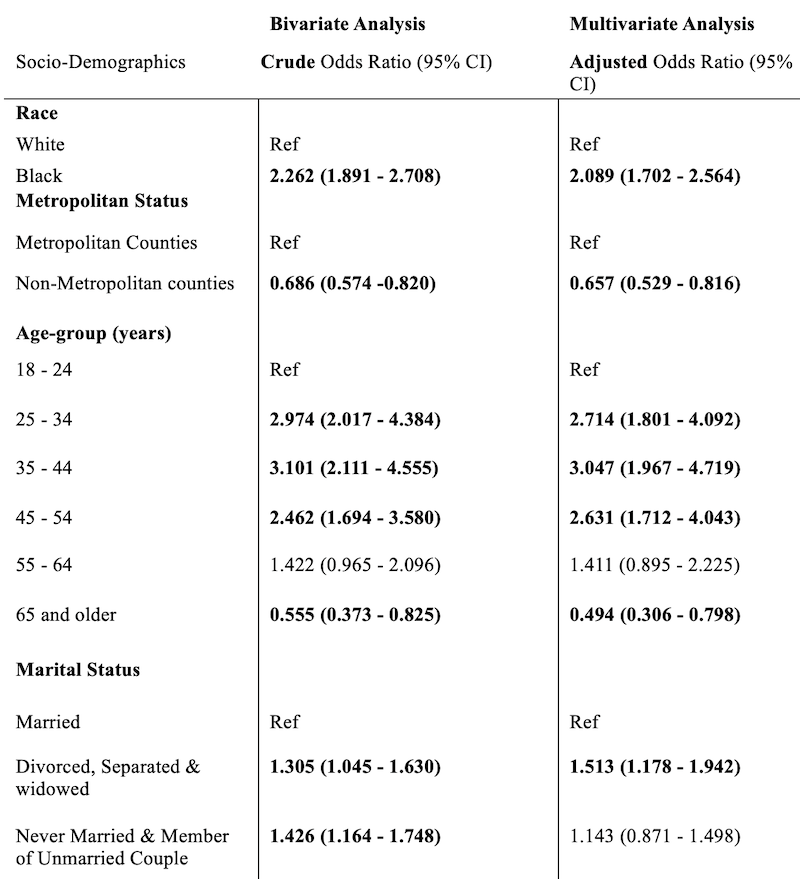
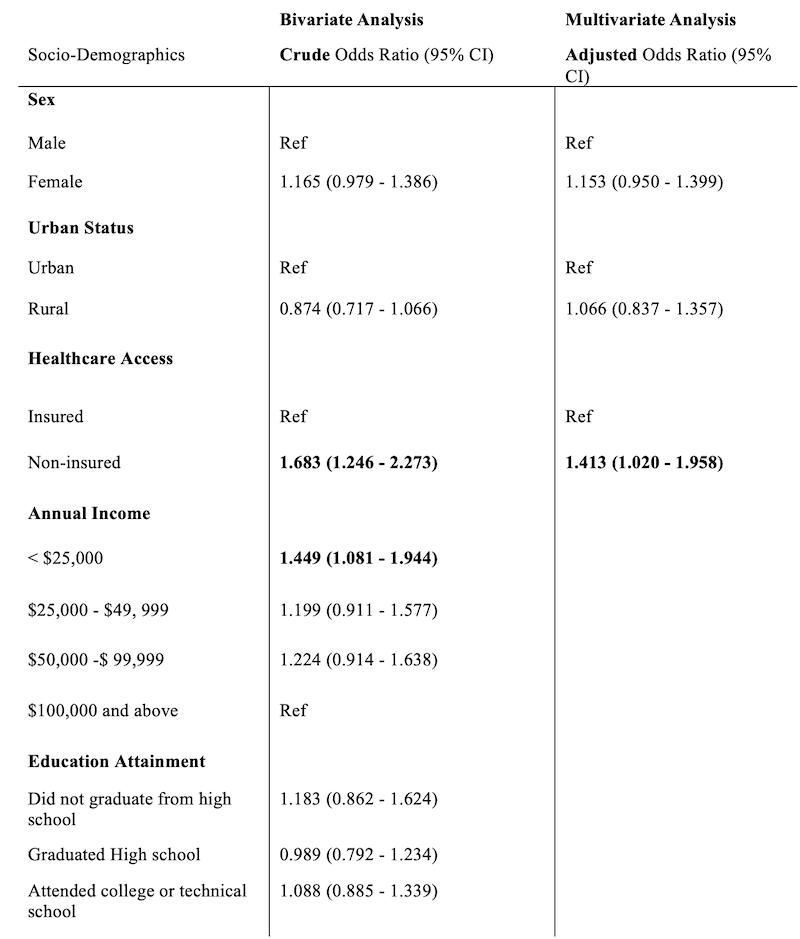
Tables 3 and 4 display the bivariate and multivariate associations between HIV testing history and selected socio-demographic variables. Factors that are significantly associated with ever being tested for HIV are race, metropolitan status, age categories, access to healthcare, and marital status. Specifically, African Americans have twice the odds of being screened for HIV compared to Whites (AOR: 2.089; 95% CI: 1.702 – 2.564).
Similarly, individuals residing in non-metropolitan counties are 31.4% less likely to have been tested for HIV compared to those in metropolitan areas (AOR: 0.686; 95% CI: 0.574 – 0.820).
The likelihood of being tested for HIV screening demonstrates significant variation across different age groups. Compared to respondents aged 18-24 years, those in the age categories of 25-34 years, 35 – 44 years, and 45 – 54 years were more likely to have taken HIV screening, with adjusted odds ratios being 2.714 (95% CI:1.801 – 4.092), 3.047 (95% CI:1.967 – 4.719), and 2.631 (95% CI:1.712 – 4.043), respectively. For individuals within the 55-64 age bracket, the likelihood of taking HIV screening was comparable to the 18-24 years age group (AOR: 1.411; 95% CI: 0.895 – 2.225).
Conversely, respondents aged 65 years and older were less likely to have taken an HIV test compared to the reference category (AOR: 0.494; 95% CI: 0.306 – 0.798). Regarding marital status, the divorced, separated, or widowed were more likely to have taken HIV screening (AOR:1.513; 95% CI:1.178 – 1.942) compared to those who were married. In contrast, individuals who have never married or members of unmarried couples exhibit similar odds of taking HIV screening as the married (AOR:1.143; 95% CI:0.871 – 1.498). Lastly, relative to people with health insurance coverage, the uninsured have higher odds of ever being tested for HIV, (AOR: 1.413; 95% CI: 1.020 – 1.958).
This study shows that there is a significant positive association between HIV testing and being African American, living in metropolitan areas, being a divorcee, separated or widow, uninsured, and being in the age category 25–54 years in Mississippi. African Americans have twice the odds of ever being tested for HIV compared to Whites. This finding is consistent with previous research conducted in the United States.10,11 Gerbi et al.,10 investigated factors associated with HIV testing among the adult population in the U.S. and found that African Americans had twice the odds of being screened for HIV as Whites.
The higher screening rate among African Americans might reflect targeted efforts to address higher HIV morbidity and mortality rates among the black population, or an increased level of awareness and risk perception for HIV infection.7,10,11,12 Likewise, the association may also suggest the success of outreach programs targeted at the minority population.12
Further, individuals living in non-metropolitan counties have 31.4% lesser odds for HIV test compared to those living in metropolitan areas. This result aligns with the literature,11 suggesting that residing in metropolitan areas is associated with higher odds of being tested for HIV. It perhaps mirrors better access to healthcare services, widespread health education, and targeted public health awareness campaigns readily available in metropolitan areas.
Our results also suggest that adults in the age groups 35-44 years, 25-34 years, and 45-55 years are most likely to have been screened for HIV compared to those in the 18-24 years age group. While the elderly (adults 65 or older) are least likely to have been screened for HIV. Similar findings were reported in a previous study.11 Benavides-Torres et al.,11 examined factors associated with lifetime HIV screening in Texas and found that age categories 24 -34 years, and 35-44 years were positively associated with higher odds of HIV screening compared to individuals aged 18-24 years among the white population. Additionally, Funk et al,13 investigated factors associated with HIV testing among African Americans in the United States.
They also observed a significant positive correlation between the age groups 24 -34 years, 35-44 years, and 45 – 54 years and HIV screening among African Americans, whereas those aged 55 years and older were less likely to have undergone HIV testing.13
This analysis also found that having health insurance coverage does not necessarily correlate with more utilization of HIV screening services among the adult population in Mississippi. Rather, individuals without health insurance exhibit a greater propensity for HIV testing compared to their insured counterparts.
Specifically, the uninsured segment demonstrates a 41.3% increased likelihood of ever being tested for HIV relative to those with health coverage. This observation echoes the conclusion drawn in prior investigations by Sankoff et al,14 and Merchant et al.15 Sankoff et al,14 concluded that uninsured patients are more likely to accept and complete routine opt-out HIV screening than those with health insurance. They estimated the relationship between payer status and HIV testing by race/ethnicity among emergency department patients at Denver Health, in Colorado.14 Similarly, Merchant et al,15 reported in their study on the variation in HIV testing history across demographic characteristics in the U.S. emergency departments that individuals with private health insurance were less likely to have been tested for HIV. One plausible interpretation for this finding could be attributed to a phenomenon of aversion to HIV screening among the insured populace, potentially driven by concerns surrounding employment security.14
Lastly, persons who are divorced, separated, or widowed demonstrate significantly higher odds of undergoing HIV screening compared to their married counterparts. Those who have never married or who are part of unmarried couples exhibit an insignificant positive association with HIV screening. This suggests that being unmarried or part of an unmarried couple does not imply higher odds of HIV testing compared to the married. These observations agree partly with the findings by Benavides-Torres et al.11 They found a significant association between HIV testing and never married, divorced, and separated. Contrarily, our analysis reveals a positive but insignificant association between HIV screening and being unmarried or part of an unmarried couple. Similar findings were also reported by Merchant et al.15 By implication, our findings may suggest a higher risk perception and awareness of HIV among the divorced, separated, or widowed compared to the married, never married, or part of an unmarried couple individuals in Mississippi.