Wait, What? PLAs: Parenting, Leadership, and Public Health Advocacy in the Time of Crisis
By Jackie Leung
Taking Back the Micronesian and Pacific Islander in API Heritage Month: The Importance of Data Disaggregation
Cadets performed the Haka Dance during the eighth annual West Point Asian Pacific American Observance Celebration Friday at Trophy Point. A Haka is a traditional posture dance form with shouted accompaniment of the Maori of New Zealand. (Photo by The U.S. Army)
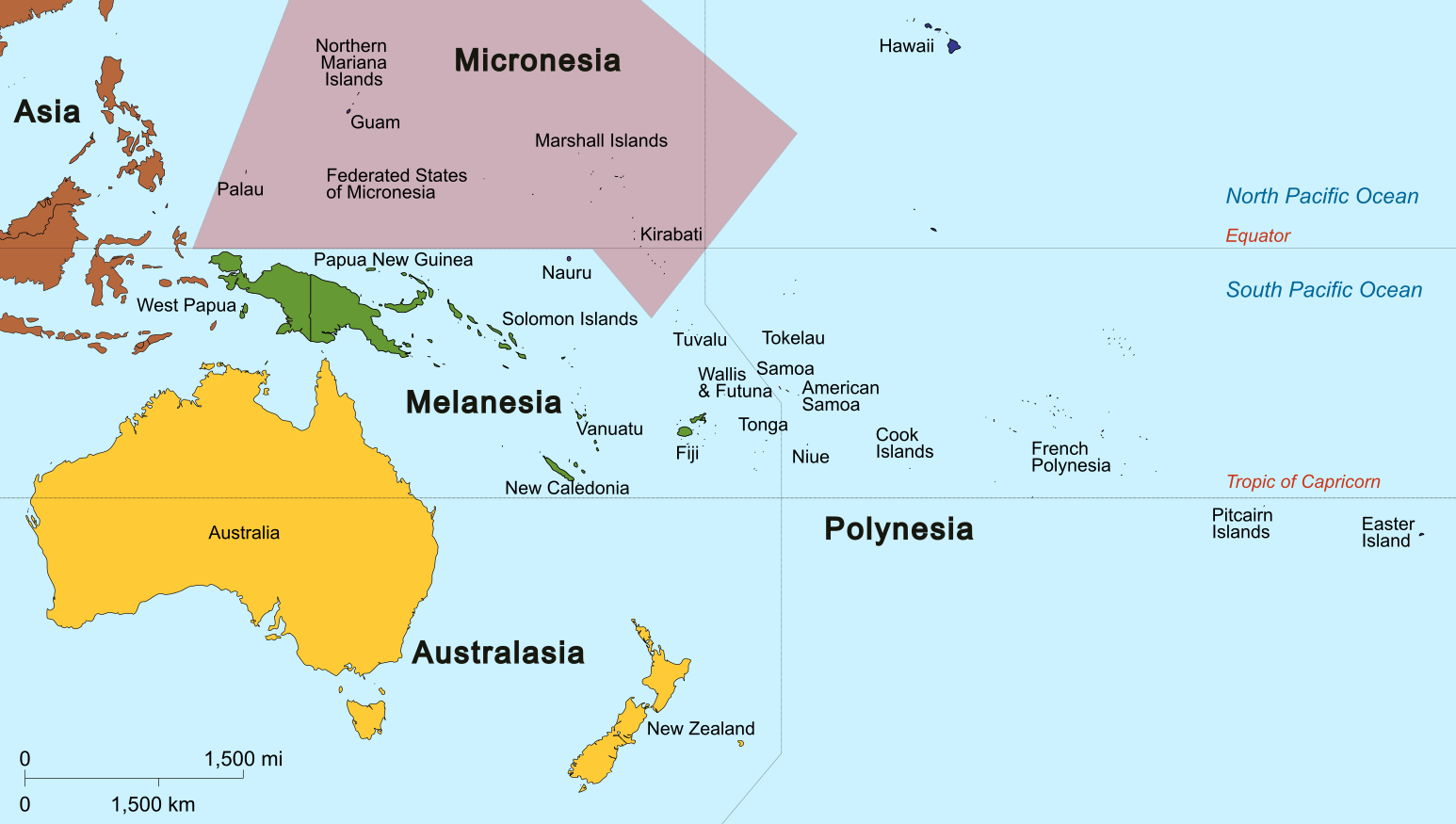
Oceania UN Geoscheme - Map of Micronesia, Melanesia, and Polynesia.
As Pacific Islanders are already viewed as a minority, Micronesians are further buried into the “AAPI” category, hiding the health disparities of an overlooked community. Multiple studies have indicated that the various categories and definitions of race and ethnicity affect health disparity outcomes (Bacong, Holub & Porotesano, 2016; Wang, Gee, Bahiru, Yang, Hsu, 2020). These same studies have reported that the health concerns of Native Hawaiian, Pacific Islanders, and Micronesians are then buried with the larger “Asian American” title. The results are then inaccurate, and future social service or outreach work results in unnecessary interventions that does not benefit or serve the community. At the same measure, the underreporting of the data results in less attention to the needs and well-being of the Micronesian community.
Another danger associated with continuing to link AAPI together is that both are then labeled as achievers, or stereotyped as the ‘model minority myth.’ The model minority myth holds that a certain group, often Asian Americans, are successful, while other minority groups are viewed as unsuccessful, yet are compared to ‘successful’ groups. In doing so, this not only causes strive between Asian Americans and Pacific Islanders, but also a rift in between groups. For example, Hmong Americans are a minority within the Asian community, and have significant health issues including economic challenges in comparison to other East Asian groups. At the same time, Pacific Islanders, especially Micronesians, are then uplifted as more successful than they actually are, or the focus is on health needs that is not centered on their particular cultural needs.
This is why it is important to public health to separate and disaggregate the data. Separating Asian American and Pacific Islanders from each other and within each group would show the reality between the groups and within subgroups. It is imperative that public health continues to address the need to separate the data. To not do so is a disservice to the community and perpetuates further harm. Racism is a public health crisis. Separation of data is one step towards harm reduction against an already marginalized, often overlooked community.
ODPHP, (26, April 2021). May National Observations: Hepatitis Awareness, Physical Fitness, Women’s Health, and More! https://tinyurl.com/y5o64n8a
Bacong, A. M., Holub, C., & Porotesano, L. (2016). Comparing Obesity-Related Health Disparities among Native Hawaiians/Pacific Islanders, Asians, and Whites in California: Reinforcing the Need for Data Disaggregation and Operationalization. Hawai’i Journal of Medicine & Public Health: A Journal of Asia Pacific Medicine & Public Health, 75(11), 337–344.
Wang D, Gee GC, Bahiru E, Yang EH, Hsu JJ (2020). Asian-Americans and Pacific Islanders in COVID-19: Emerging Disparities Amid Discrimination. J Gen Intern Med. 35(12):3685-3688. doi: 10.1007/s11606-020-06264-5.